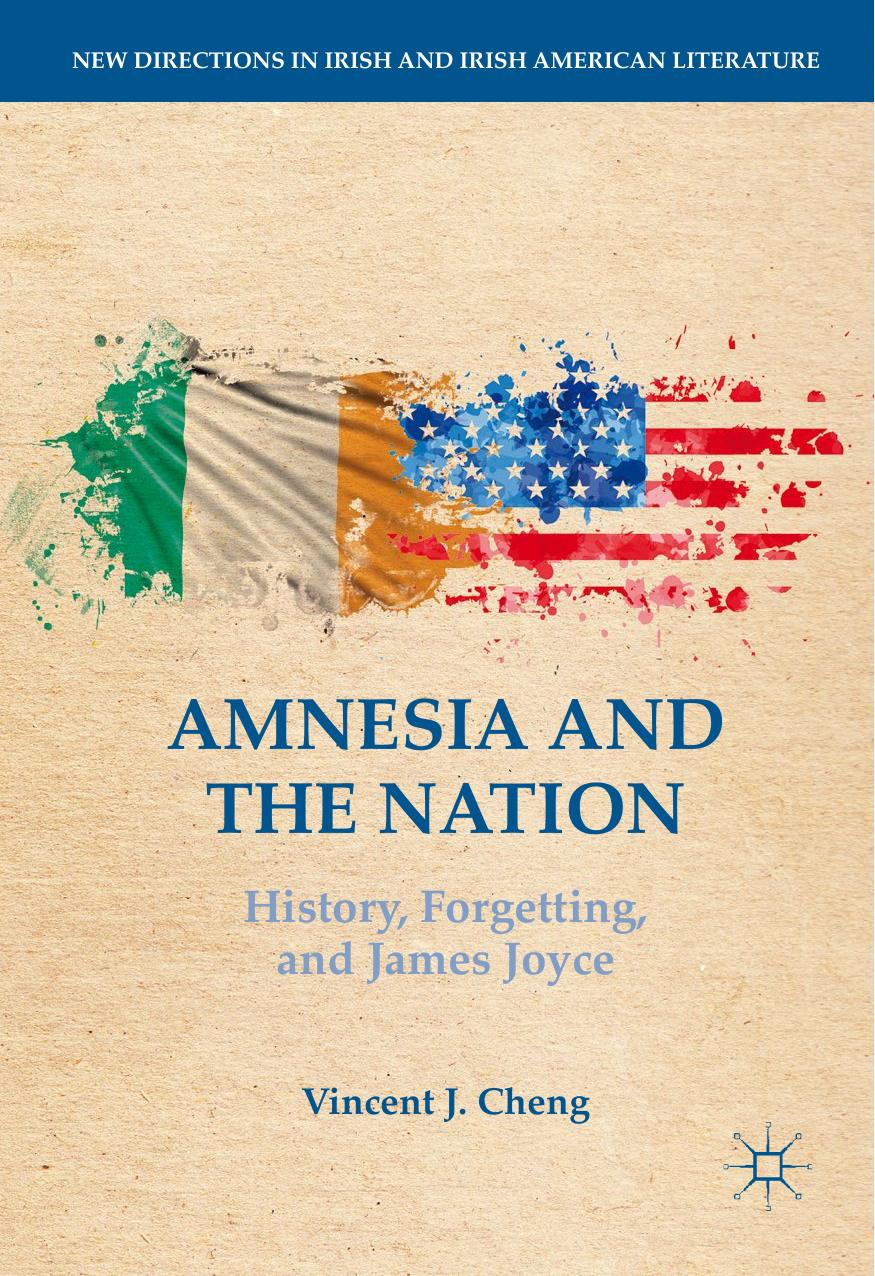
Amnesia and the Nation by Vincent J. Cheng
Author:Vincent J. Cheng
Language: eng
Format: epub, pdf
Publisher: Springer International Publishing, Cham
The Memory of 1916: Hurleysticks, Martyrology, and the Easter Rising
www.ireland.ie—the official website for the Easter Rising Centenary in Ireland—stated on its homepage in 2016:Each year at Easter, we remember and honour those who took part and gave their lives during the Easter Rising, and with the launch of an extensive programme of events, 2016 brings about a massive commemoration centred in the city where it all took place, Dublin.
The commemoration program was indeed “massive,” beginning with the “synchronised wreath-laying ceremonies at strategic points around Dublin, starting with Dublin Castle.” The Irish Times made a valiant attempt to help the interested individual, whether Irish citizen or visitor, sort through all the “official ceremonies and hundreds of local initiatives”—by listing, on its website, a selected and annotated list of “50 events for 2016.” Such celebrations were widespread and worldwide: even the Hibernian Society in Salt Lake City, Utah (where I live), with the official imprimatur and financial backing of the Irish Consulate in San Francisco, programmed no less than ten events (including poetry readings, films, concerts, parades and so on) during spring 2016 in commemoration of the Rising. In Ireland, poems (by poets such as Paul Muldoon and Eavan Boland), plays, performances, songs, films, documentaries, television programs, and so forth were all officially commissioned for the 1916 ballyhoo. Which is to say that the massive and coordinated weight of official, governmental publicity—and memory-making—were all thrown behind the effort to commemorate and memorialize the Easter 1916 Rising. (This has not always been true.) So it is in some ways quite remarkable, and rather startling, that a brief and aborted uprising—questionably planned, clumsily botched, and quite unpopular with the general populace at the time (indeed, when the captured rebels were led through the streets of a bombed-out Dublin, they were spat on by the Dubliners)—that it could have, 100 years later, reached this high canonical, iconic status of state-sponsored commemoration and historical memorialization.
* * *
James Joyce had almost nothing to say about 1916 directly. Richard Ellmann reports that “Joyce followed the events with pity; although he evaluated the rising as useless, he felt also out of things”; his ambivalence was “balanced between bitterness and nostalgia,” and he declined an invitation from a Swiss publication to write an analysis of the Rising (Ellmann II, 399). But 1916 has long been significant in Irish history for a number of other reasons, too, most notably (especially in the North) for the Battle of the Somme and the thousands of Irish soldiers who died in France at that battle. For Joyceans, 1916 also marks the publication of A Portrait of the Artist as a Young Man.
Neither Portrait, nor its earlier first-draft manuscript Stephen Hero, have really been discussed in terms of the later events in 1916.7 But I would like to suggest that Joyce’s bildungsroman, if not prophetic, at least anticipates the Easter Rising in a number of interesting ways. For the young Stephen Dedalus of Stephen Hero and A Portrait, any force that would constrict his personal freedom and development is suspect, including the Nationalist/Celticist movement.
Download
This site does not store any files on its server. We only index and link to content provided by other sites. Please contact the content providers to delete copyright contents if any and email us, we'll remove relevant links or contents immediately.
4 3 2 1: A Novel by Paul Auster(12372)
The handmaid's tale by Margaret Atwood(7756)
Giovanni's Room by James Baldwin(7325)
Asking the Right Questions: A Guide to Critical Thinking by M. Neil Browne & Stuart M. Keeley(5757)
Big Magic: Creative Living Beyond Fear by Elizabeth Gilbert(5754)
Ego Is the Enemy by Ryan Holiday(5413)
The Body: A Guide for Occupants by Bill Bryson(5080)
On Writing A Memoir of the Craft by Stephen King(4931)
Ken Follett - World without end by Ken Follett(4722)
Adulting by Kelly Williams Brown(4565)
Bluets by Maggie Nelson(4547)
Eat That Frog! by Brian Tracy(4525)
Guilty Pleasures by Laurell K Hamilton(4439)
The Poetry of Pablo Neruda by Pablo Neruda(4097)
Alive: The Story of the Andes Survivors by Piers Paul Read(4018)
White Noise - A Novel by Don DeLillo(4002)
Fingerprints of the Gods by Graham Hancock(3991)
The Book of Joy by Dalai Lama(3974)
The Bookshop by Penelope Fitzgerald(3843)
